


Plastic Greenhouse Construction: Benefits and Steps from Design to Growing
Building a plastic greenhouse does not begin with buying a frame and stretching a cover over it. It begins with a few questions: What crop will you produce? What is the site's climate? Where will water and energy come from? And which market will buy the harvest?
A greenhouse is a suitable choice when its structure, covering, equipment and cropping plan work together. Spain's experience shows that even within one country, a single design is not used for every region and crop.
This guide reviews the benefits of plastic greenhouses and the decisions involved, from assessing the land to starting cultivation.
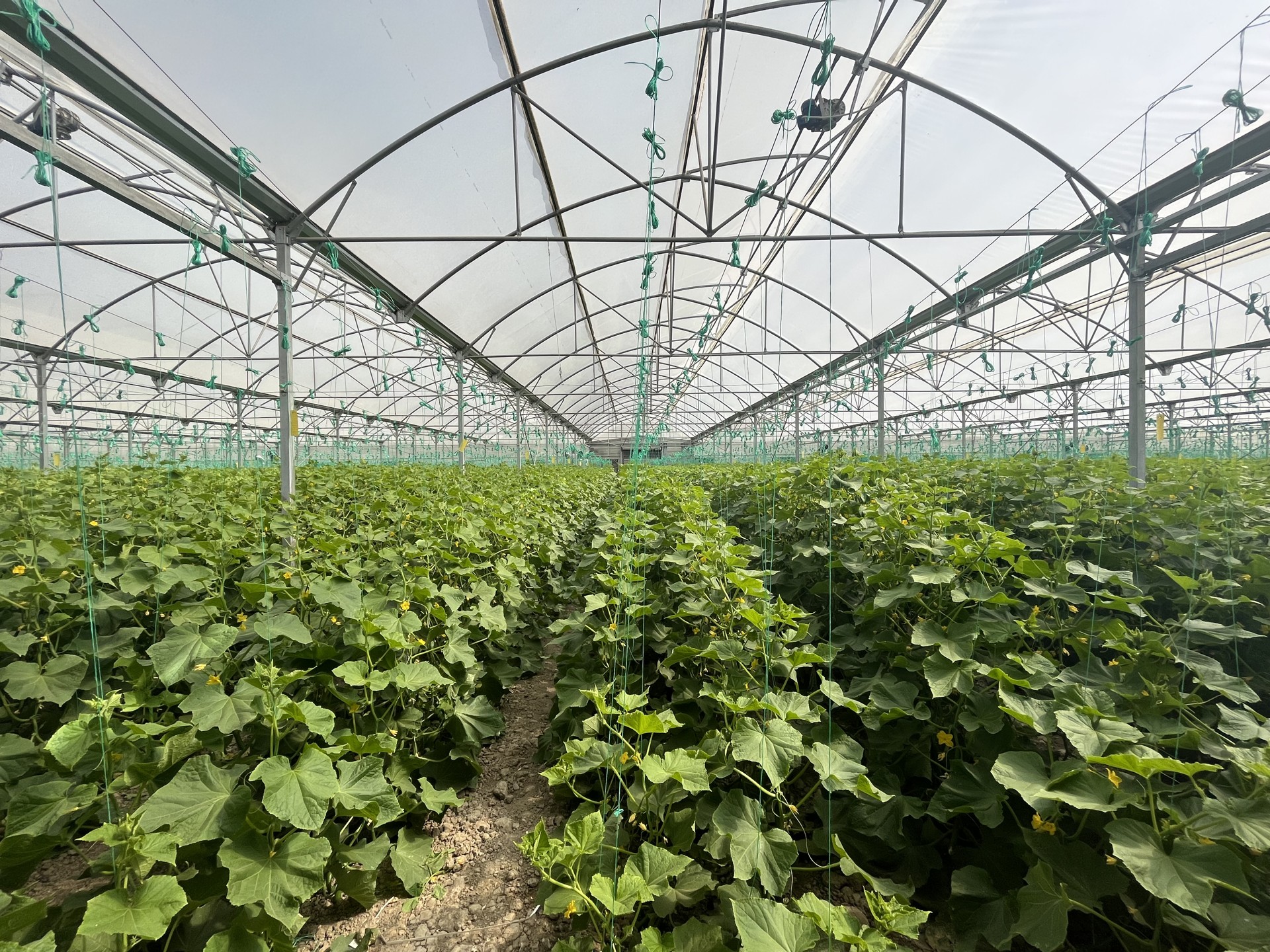
What is a plastic greenhouse?
Its main covering is made from agricultural films. “Plastic” describes the cover; the frame can be an engineered steel structure with climate-control equipment.
A plastic greenhouse is therefore not necessarily a simple tunnel or temporary structure. The category includes standalone tunnels and multi-span greenhouses equipped with roof ventilation, irrigation and automated controls. Novagric's project in Almería, Spain, combines a multi-span structure, roof and side vents, climate control and drainage-water collection. Source: Novagric's Almería project
For services and construction options, see Rah Nik Kesht greenhouse structures.
Benefits of building a plastic greenhouse
1. Choosing an investment level that suits the project
The range of structures and equipment makes it possible to design around the crop, production season and facilities available at the site.
FAO's guide discusses Mediterranean greenhouses with simpler climate control alongside advanced systems. The important trade-off is that a lower initial investment may mean greater limitations in climate control and the production period. The cheapest frame is therefore not necessarily the most suitable economic choice. Source: FAO's Mediterranean greenhouse guide
2. Selecting a cover for the climate and crop
The cover is more than a protective layer: it affects incoming light and the internal environment. Its optical and thermal properties, condensation control, durability and maintenance requirements should be assessed.
Spain's ULMA also relates film selection to climate and crop requirements. Greater thickness or more layers alone do not make a cover suitable for every greenhouse. Source: ULMA covers and equipment
3. Equipping the greenhouse for professional production
Multi-span structures can be designed from the outset for irrigation, fertigation, heating, shading and climate control. Installation space, structural capacity and service routes need assessment before construction.
The equipped Almería project demonstrates that plastic covering is compatible with advanced cultivation and drainage management. Water savings nevertheless depend on suitable collection, treatment and management systems, rather than the cover alone. Source: Novagric project equipment
4. Better management of the production period
Protected cultivation can enable earlier harvests or extend cultivation through some conditions that are unsuitable outdoors. Year-round production is not an automatic result of building a greenhouse; it depends on the local climate, crop and equipment.
Novagric's tunnel-selection guide also stresses plant height, project size, light and ventilation. Greenhouse selection should start with the needs of the crop. Source: tunnel greenhouse selection guide
What can we learn from Spain?
The main lesson is not to copy a roof shape, but to match the design to production conditions.
Design ventilation from the beginning
Vent locations, their actual opening area and air inlet and outlet paths must be decided before construction. In warm regions, inadequate ventilation can turn the benefits of protection into excessive heat and humidity.
ULMA offers different roof and side openings for different climates. Research on Spanish Mediterranean greenhouses has also examined the effect of larger side-vent areas on the internal climate and tomato production. These sources treat ventilation as a core design element, not equipment to add later. Source: ULMA, Spanish ventilation research
If vents are fitted with insect netting, the net's specifications and effect on airflow must also be included in the design.
Choose height and span around working requirements
The interior must accommodate plant height, training methods, staff movement and equipment. Novagric's taller greenhouses in Murcia combine more internal space with enlarged roof and side openings and better machinery access.
Greater height alone is therefore not a solution; it should be assessed together with ventilation and operating design. Source: greenhouse experience in Murcia
Structural resistance requires calculations
Names such as “Spanish” or “modern” do not replace structural calculations. Wind and precipitation resistance must be assessed for the project location and the specific structure. Connections, bracing, foundations and equipment and crop loads are also relevant. Source: Novagric on wind and snow resistance
Greenhouse construction stages: where to start
The table provides a practical framework for discussions with the designer and contractor.
| Stage | What to assess | Required output |
|---|---|---|
| Define the objective | Crop, production season and sales market | Initial cropping and sales plan |
| Assess the land | Access, slope, drainage and climate | Site suitability assessment |
| Assess resources | Water quantity and quality, electricity and fuel | Realistic operating capacity |
| Design | Structure, cover, ventilation and services | Coordinated drawings and specifications |
| Estimate | Construction, equipment and operating costs | Financial proposal with clear scope |
| Build | Civil works, structure and equipment installation | Project delivered to approved drawings |
| Commission | Equipment testing and operator training | Readiness to begin cultivation |
Before ordering the structure, ask the designer to specify what the quoted price includes and what must be supplied separately.
What affects plastic greenhouse construction costs?
A price per square metre is insufficient for comparing offers unless the scope is clear.
Separate these budget items:
- Site preparation and civil works;
- Structure, connections and covering;
- Vents and ventilation;
- Required heating, cooling and shading;
- Water supply and distribution, irrigation and fertigation;
- Electricity, controls and monitoring equipment;
- Installation, transport, commissioning and training;
- Working capital to start and complete the first crop cycle.
This is our proposed framework for transparent contract comparisons. Compare prices only when structural specifications, equipment and delivery obligations are equivalent.
Limitations to understand before construction
The cover needs maintenance and replacement
Environmental conditions, film quality, installation and maintenance affect covering performance. Obtain specifications and warranty terms from the supplier of the particular film; a single lifespan cannot be assigned to all covers. Novagric's materials guide also treats the cover and its fixings as defined parts of the structural system. Source: greenhouse materials and structures
Winter humidity matters as much as summer heat
Closing vents to retain heat in cold weather can complicate humidity management. Research by the Chinese Academy of Agricultural Sciences on cold-region greenhouses examines simultaneous temperature and humidity control.
The practical implication for Iranian projects is that winter planning should extend beyond selecting a heater. Source: CAAS temperature and humidity research
Another country's experience is not a ready-made solution for your land
For example, Turkey's Agrobay describes using geothermal heating at its facilities. This highlights the importance of the energy source, but the same advantage cannot be assumed for land without access to that resource. Source: Agrobay profile
Plan cultivation equipment before the structure is finished
In trellised crops, row layout and plant-support systems must be coordinated with the structure. Choosing greenhouse twine and plant clips is part of crop preparation; the designer must also assess the capacity of the complete support system.
The need for greenhouse shade net should likewise match the crop's light requirements and heat-control plan. Buying individual items without a coordinated design may lead to rework.
Frequently asked questions
Are plastic greenhouses suitable for commercial production?
Yes; equipped commercial multi-span examples exist. The suitability of your project depends on design, climate, resources and the production plan.
Does building a greenhouse alone reduce water use?
No. Irrigation methods, fertigation schedules and drainage management affect water use. The covering alone does not guarantee savings.
Can a Spanish greenhouse design be copied exactly?
Learning from it is useful, but the design must be reviewed for local wind, precipitation, temperature, water and available facilities.
What information is needed for a construction proposal?
Prepare the site location, area, intended crop, production season, water and energy conditions, and budget range. These details make an initial proposal more accurate.
From design to cultivation with Rah Nik Kesht
To discuss plastic greenhouse design and construction, share your site details and production objectives with Rah Nik Kesht. The project should begin with needs assessment and connect design, construction, equipment and crop preparation.
The objective is a working space where production conditions can be managed and operations planned.


