




Insect attraction cards and tapes; a comprehensive guide to sticky attraction cards and tapes, greenhouse pest monitoring and control
Pest control is one of the most important challenges in greenhouse and horticultural production. In addition to reducing plant yield, increasing the density of flying pests causes the transmission of pathogens, reduces product quality, and increases production costs. In such circumstances, the continuous use of chemical pesticides, although effective in the short term, will eventually lead to resistance in the pest population, a decrease in the population of beneficial insects, the persistence of toxins in the crop, and increased environmental pollution.
For this reason, non-chemical and low-risk methods have gained a special place in modern agriculture. Sticky card It is one of the simplest, most economical, and most effective mechanical control tools that allows for the identification and reduction of populations of many flying pests without the use of toxic substances.
In addition to reducing direct pest damage, this tool provides greenhouse managers with valuable information about the timing of emergence, population growth trends, and severity of infestation. For this reason, the greenhouse sticky card is now considered a key component of integrated pest management (IPM) programs.
The scientific principle of insect attraction cards and tapes
The yellow sticky trap works based on the behavioral response of many insects to specific wavelengths of light. Research has shown that most flying pests respond to colors with wavelengths of approximately 300 to 650 nanometers. Among them, the yellow spectrum with wavelengths of approximately 530 to 580 nanometers is the most attractive to a large group of pests.
The reason for this is the insect’s visual system. Many herbivorous species recognize the color yellow as similar to young leaves, growing organs, or suitable food sources. As a result, they move towards the yellow surface without the need for any chemicals.
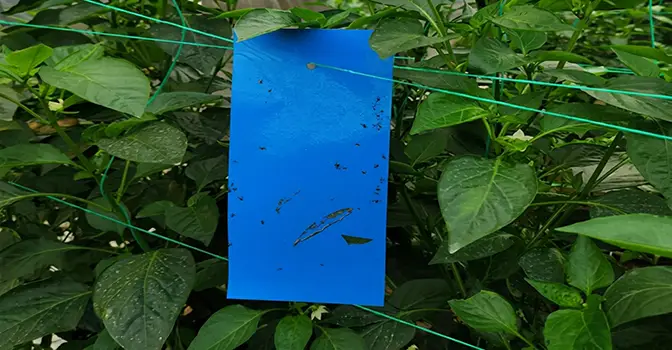
In contrast, the blue insect card has a different reflectance spectrum and is used more often to attract thrips. Choosing the right color for the target pest is one of the determining factors in the success of a control program, as using the wrong color can significantly reduce the capture rate or attract non-target species.
The mechanism of action of insect-attracting cards and tapes
The sticky insect trap works in two main stages. In the first stage, the color of the card acts as a visual stimulus and attracts flying insects. In the second stage, the surface of the card, which is covered with a layer of special glue, prevents the insect from detaching and traps it.
The glue used is usually a type of stable polymer or plant-based glue that maintains its adhesive properties for a long time. Some professional products also use a paraffin-free, living-based glue that does not dry out even in the presence of air and is also resistant to water.
In this process, no toxic substances enter the environment and pest removal is achieved solely by trapping adult insects. This feature makes insect attraction cards and tapes one of the safest mechanical control methods for closed environments such as greenhouses.
Structure and technical characteristics of insect-attracting cards and tapes
The quality of construction of an insect-attracting sticky card has a direct impact on its durability and performance. Most professional cards are made of glossy PVC or polypropylene plastic. In addition to mechanical strength, these materials provide good light reflection, which plays an important role in increasing the visual attraction of insects.
The surface of the card is usually coated with a uniform layer of adhesive approximately 40 to 50 microns thick. This thickness maintains adhesive strength while preventing the adhesive from flowing at high temperatures.
Many products use a silicone paper layer to protect the adhesive, which is removed before installation. This coating prevents contamination of the adhesive surface during transportation.
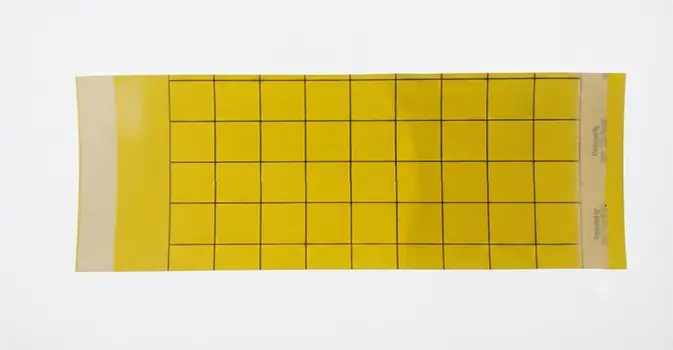
Some cards are designed to be double-sided to increase the effective surface area of the catch. Also, in professional models, grid lines or scales are printed on the card to allow for more accurate pest counts and recording of pest monitoring data.
In terms of environmental resistance, standard cards must have the following characteristics:
- Good resistance to ultraviolet (UV) radiation
- Resistance to humidity and precipitation
- Glue does not dissolve in water.
- Stability in temperature fluctuations
- Maintains adhesion in contact with air
- Mechanical resistance to tearing and bending
These features allow the card to be used for relatively long periods without noticeable performance degradation.
A standard greenhouse adhesive card must have a set of technical features at the same time to provide proper performance in different environmental conditions.
The card should have a uniform colour and suitable reflectivity to maintain its visual appeal to the target pests. Color changes caused by sunlight or poor quality raw materials can reduce hunting efficiency.
The adhesive must also have the appropriate viscosity so that the insect cannot detach from the surface after initial contact, but at the same time, dust or light particles in the environment do not quickly deactivate the card surface.
Common card sizes are usually 10 x 24 cm or 20 x 30 cm, although larger sizes are also produced for mass pest capture. The selection of the appropriate size should be based on pest density, greenhouse size, and intended use.
Scope of application of insect-attracting cards and tapes
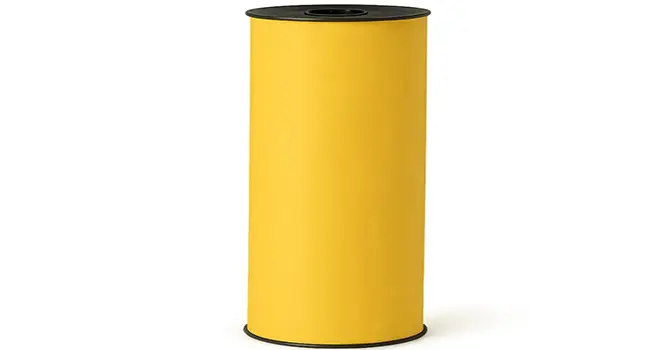
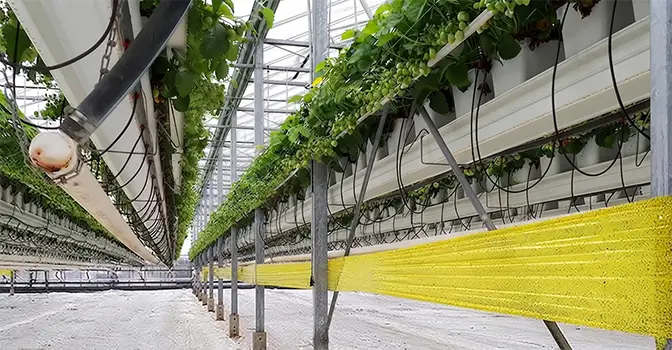
Insect attraction cards and tapes are used in a wide range of agricultural production systems due to their non-chemical performance and ease of use. The most important places to use this colored insect trap are vegetable and summer greenhouses, ornamental plants, transplants, and plant propagation centers, because in these closed environments, the possibility of continuous monitoring and rapid reduction of pest populations is of great importance.
In orchards, vineyards, nurseries, and farms, sticky yellow cards are also used to monitor the emergence of pests, determine population growth trends, and implement early warning operations. In some crops, such as pistachios, installing cards at the beginning of the growing season and before the pest lays eggs can reduce the population of overwintering adults.
The most important pests that are controlled or monitored with the yellow insect card are:
- Greenhouse whitefly
- Winged aphid
- Leafminer flies
- Mushroom fly
- Leafhoppers
- Psyllids
- Some species of fruit flies
In contrast, the blue insect card is mainly used for catching and monitoring pests such as thrips. Therefore, the choice of color should be made according to the target species for maximum efficiency.
Benefits of insect-attracting cards and tapes
In addition to reducing pest populations, the use of insect sticky traps provides the grower with valuable management information. The most important advantage of this method is the ability to detect infestations early. In many cases, seeing a few insects on the card allows control operations to be initiated before any visible damage is done to the plant.
From an economic perspective, yellow sticky traps are one of the most cost-effective pest control tools. Their cost of procurement and installation is lower than many chemical methods and they do not require complex equipment.
Other advantages of this method include the following:
- Reducing the use of chemical pesticides
- Reducing the likelihood of resistance developing in pest populations
- Safety for plants, humans and the environment
- No toxic residue on the product
- Possibility of use in organic farming
- Easy installation and transportation
- Can be used in small and industrial greenhouses
- Possibility of recording and analyzing trends in pest population changes
- Fully compatible with integrated pest management (IPM) programs
For this reason, sticky cards are not only a control tool, but also a means of managerial decision-making.
Principles of installing or implementing insect-attracting cards and tapes
The location of the card is one of the most important factors affecting the effectiveness of the sticky card. In greenhouses, the best location is usually in the crown of the plant, or about 70% of the height of the plant. As the plant grows, the height of the card should gradually increase so that it is always in the flight path of the pests.
Some sources also recommend a distance of about 15 to 20 cm above the plant crown for many greenhouse crops. The exact height selection should be made according to the behavior of the target species.
Cards are usually installed vertically, but for some pests, such as minnows, horizontal installation can also increase capture efficiency.
To prevent performance degradation, it is essential to observe the following points:
- The card should not have direct contact with the leaf or branch.
- Do not expose to heavy dust.
- The path of workers or equipment should not cause continuous contact with the card.
- Use a suitable clamp, wire, or holder for installation.
- In large greenhouses, cards should be distributed evenly across all sections.
Density or amount of insect-attracting cards and tape
The number of insect attraction cards should be determined based on the purpose of use. Using too few cards to control a large pest population will not produce the desired results, and conversely, using too many cards in the initial monitoring situation is not economically justified.
Common values are:
| Approximate dosage | Purpose of use |
|---|---|
| 1 card per 200 square meters (about 50 cards per hectare) | Monitoring and tracking |
| 1 card per 10 square meters | Mass pest hunting |
| Up to 1 card per 2 square meters | Severe pollution |
| At least 1 card per tree at the beginning of the season | Pistachio garden |
In greenhouse pest control programs, increasing card density is only recommended when pest populations have exceeded an acceptable threshold. Decisions about installation density should be made based on pest monitoring results and actual field conditions.
Tips for maintaining insect-attracting cards and tape
Proper storage will increase the durability and effectiveness of the sticky insect trap. Unused cards should be stored in a dry, cool environment, away from direct sunlight, to prevent deterioration of the glue and color.
Cards should also not be subjected to excessive pressure during transportation, as bending or damage to the adhesive surface will reduce performance.
It is also recommended to observe the following during operation:
- Cards covered in dust or insects should be replaced.
- Avoid hand contact with the sticky surface.
- Do not place cards near extreme heat sources.
- After the end of the usage period, used cards should be collected from the environment and disposed of appropriately.
Proper maintenance will ensure that the sticky insect-attracting card maintains the highest possible efficiency throughout its operating period.
Application in Integrated Pest Management (IPM)
Integrated pest management (IPM) is now recognized as the most effective pest control strategy in sustainable agriculture. The goal of this approach is not to completely eliminate pests, but to keep their populations below the threshold of economic damage by using a combination of methods.
In this context, the greenhouse sticky card serves as the first monitoring tool. The information from the cards determines whether the pest population is increasing and whether it is time to implement other control methods.
Combining yellow sticky traps with the following methods increases the effectiveness of an IPM program:
- Release of natural enemies such as parasitoid wasps and predatory insects
- Maintaining greenhouse hygiene and removing contaminated residues
- Using insect screens at entrances
- Proper ventilation and humidity management
- Removal of infected plants
- Targeted and limited use of pesticides only if the population crosses an economic threshold
Common mistakes in using insect attraction cards and tapes
A significant portion of the decline in the effectiveness of the sticky yellow card is due to implementation errors, not the quality of the product itself. Awareness of these errors can improve the performance of the control system.
One of the most common mistakes is installing the card at a fixed height. As greenhouse crops such as tomatoes, cucumbers or peppers grow rapidly, the distance between the card and the plant crown increases, reducing the amount of insect attraction.
Another mistake is using an insufficient number of cards in conditions of heavy infestation. Low density is only suitable for pest monitoring and the number of cards should be increased in mass pest hunting programs.
Placing the cards in direct contact with the leaves will also cause the sticky surface to become coated and reduce trapping power. Also, placing the cards in areas that do not have good airflow or are not in the flight path of the pests will reduce efficiency.
Some operators also leave the card in place after it has become saturated. This not only reduces performance, but may also lead to a false impression of the true state of the pest population.
Practical advice about insect-attracting cards and tapes
To achieve maximum effectiveness of the insect yellow card, it is essential to follow the following recommendations.
When buying
- Choose cards with a uniform color and a glossy surface.
- Check for proper resistance to UV rays.
- The adhesive must be resistant to moisture and not dry out in the presence of air.
- It is preferable to use products with adhesives that are free of toxic substances or plant-based in organic production.
- The quality of the raw materials and the strength of the card body should be considered.
When installing
- The card should be installed at the crown of the plant or about 15 to 20 centimeters above it.
- Avoid direct contact of the card with leaves and branches.
- The cards should be distributed evenly throughout the greenhouse.
- The installation height should be adjusted as the plant grows.
- The purpose of use (surveillance or mass hunting) must be determined before determining the number of cards.
To achieve maximum efficiency
- The color of the card should be chosen according to the target species.
- Regular recording of pest monitoring data should be carried out.
- Cards should be inspected and replaced periodically.
- The use of cards should be combined with other integrated pest management (IPM) methods.
- Decisions to spray should be made based on monitoring results, not simply observing damage on the plant.
| Type | Target pests | Main feature | Benefits | Limitations | Suggested dosage | Terms of Use | Executive recommendation |
|---|---|---|---|---|---|---|---|
| Insect yellow card | Greenhouse whitefly, winged aphid, mealybug, mushroom fly, grasshopper, psyllid | Visual attraction in the yellow spectrum and sticky surface | Suitable for mass monitoring and hunting, low cost, easy installation | Does not affect non-flying stages of pests. | Monitoring: 1 card per 200 square meters; Mass hunting: 1 card per 10 to 2 square meters | Greenhouse, garden, greenhouse, farm | Adjust the height of the card as the plant grows. |
| Blue Insect Card | Thrips | More appeal for the blue spectrum | Higher accuracy in thrips monitoring | More limited use than a yellow card | Similar to yellow card, depending on pest density | Greenhouse and ornamental plants | Can be used alongside the yellow card to monitor multiple pests simultaneously |
Conclusion
Insect attraction cards and tapes are one of the most effective tools for mechanical control and pest monitoring in modern agricultural systems. By utilizing the natural behavior of insects towards specific light spectra, this tool allows for early detection of contamination and reduction of populations of many flying pests without the direct use of chemical pesticides.
The success of using yellow sticky traps does not only depend on the quality of the card, but also the correct choice of color, proper density, installation at the correct height, regular recording of monitoring data, and timely replacement of cards are the main factors determining its effectiveness. Also, for pests such as thrips, using blue insect cards alongside yellow cards will increase the accuracy of monitoring and control.
Ultimately, the greatest effectiveness is achieved when insect sticky traps are used as part of a comprehensive integrated pest management (IPM) program. Combining this method with biological control, agronomic practices, greenhouse hygiene, and targeted pesticide use will not only reduce economic losses, but also help maintain environmental health, reduce pesticide use, and develop sustainable agriculture.
Questions and answers about insect attraction cards and tapes
1- What are insect attraction cards and tapes and how do they work?
Insect attraction cards and tapes are a type of sticky insect trap that uses yellow paint and a sticky surface to attract and trap flying insects. Insects are attracted based on their natural reaction to a specific range of light wavelengths, and after contact with the sticky surface, their ability to fly and escape is eliminated.
2- Which pests is the yellow sticky card suitable for controlling?
The yellow sticky card is very effective for controlling and monitoring pests such as greenhouse whiteflies, winged aphids, mealybugs, fungus gnats, leafhoppers, and psyllids. The blue insect card is usually recommended for controlling thrips.
3- What is the difference between a yellow insect control card and a blue insect control card?
The main difference between the two traps is in color and target species. The yellow insect card is most attractive to whiteflies, aphids, mealybugs, and many flying pests, while the blue insect card is more effective at attracting and controlling thrips due to its light spectrum characteristics.
To learn about a complementary method of preventing pests, Greenhouse insect screen guide Read.


