


History of Greenhouse Construction Worldwide: From Early Plant Shelters to Smart Greenhouses
Where did greenhouse construction begin? The answer depends on what we mean by a greenhouse. There is evidence of protected cultivation in ancient Rome in the first century CE; one of the earliest known instructions for a heated greenhouse was recorded in fifteenth-century Korea; and large glass structures evolved in Europe, especially during the nineteenth century. Greenhouse history therefore cannot be reduced to a single invention in one country. [Source: doi.org] [Source: www.jstor.org]
The story of greenhouse construction is the story of humanity’s effort to depend less on seasons and weather. It developed from protecting valuable plants in winter into commercial production of vegetables, flowers and seedlings, water and nutrient management, and today, decisions supported by sensors and artificial intelligence. This article first reviews historical evidence, then examines significant national examples and their lessons for greenhouse design. All dates use the Gregorian calendar, and the year of statistical data is distinguished from the publication year of its source.
What exactly is a greenhouse, and how does it differ from protected cultivation?
A greenhouse is a covered structure for growing plants that allows some environmental conditions to be managed. “Protected cultivation” is broader: low tunnels, high tunnels, shade structures and net houses can also belong to this category. They do not all have heating, cooling or complete humidity control. Mexico’s official information system likewise distinguishes greenhouses, tunnels and shade houses within this family. [Source: nube.agricultura.gob.mx]
This distinction matters when reading statistics. The total area of covered cultivation in one country should not be compared with glasshouse area in another without checking definitions. Hydroponics is a method of managing roots and nutrition, not a building shape: a greenhouse may use soil or soilless cultivation. A vertical farm relying entirely on artificial light is also different from a sunlight-based greenhouse. [Source: www.arc.agric.za] [Source: www.dpird.nsw.gov.au]
The earliest evidence: ancient Rome and structures preceding the modern greenhouse
Columella’s De Re Rustica and Pliny’s Historia Naturalis describe ways of supplying produce for Tiberius. Janick and Paris examined these accounts in 2022: movable beds were taken into the sunshine, and frames covered with translucent lapis specularis were used in cold weather. This material was a cleavable crystalline gypsum; it should not be imagined as modern industrial glass. [Source: doi.org]
The same study identifies cucumis as an elongated melon or snake melon, rather than cucumber. These structures were precursors of greenhouses, and their exact locations have not been established with certainty. [Source: doi.org]
Fifteenth-century Korea: underfloor heating for winter cultivation
Sangayorok, attributed to the Korean court physician Jun Soon-ui, contains mid-fifteenth-century instructions for growing vegetables in winter. Sang Jun Yoon and Jan Woudstra examined this history in Garden History. Traditional ondol heating, insulated walls and translucent oiled paper worked together, addressing light, heat and moisture at the same time. [Source: www.jstor.org] [Source: etheses.whiterose.ac.uk]
This document matters because it shows that the history of heated greenhouses is not exclusively European. Its existence, however, does not prove that all later greenhouses around the world were directly modelled on Korea. A picture of a modern reconstruction is also not a photograph of a surviving fifteenth-century building.
Europe: from protecting citrus to royal orangeries
Protecting citrus and other cold-sensitive plants was an important strand of European development. Yves-Marie Allain’s Une histoire des serres traces examples of citrus cultivation and protection in Italy and the evolution of the orangery and greenhouse. Winter protection was initially the central problem; gradually, the plant shelter evolved from a room or refuge into a space with more deliberately designed lighting and heating. [Source: www.quae.com]
Germany’s historic Heidelberg garden, or Hortus Palatinus, is an important early-seventeenth-century example of garden design and plant collections. Its official history mentions an orange garden. It should not definitively be called “the world’s first greenhouse”: that designation depends on the definition of greenhouse and the documents being compared. [Source: www.schloss-heidelberg.de]
In France, the Versailles Orangery clearly illustrates architecture adapted to plants. Louis Le Vau built the original structure in 1663, and Jules Hardouin-Mansart later enlarged it. Its southern exposure, thick walls and double windows helped retain warmth. Trees stayed indoors in winter and outdoors in summer, so an orangery was not necessarily an all-glass space for continuous production. [Source: en.chateauversailles.fr]
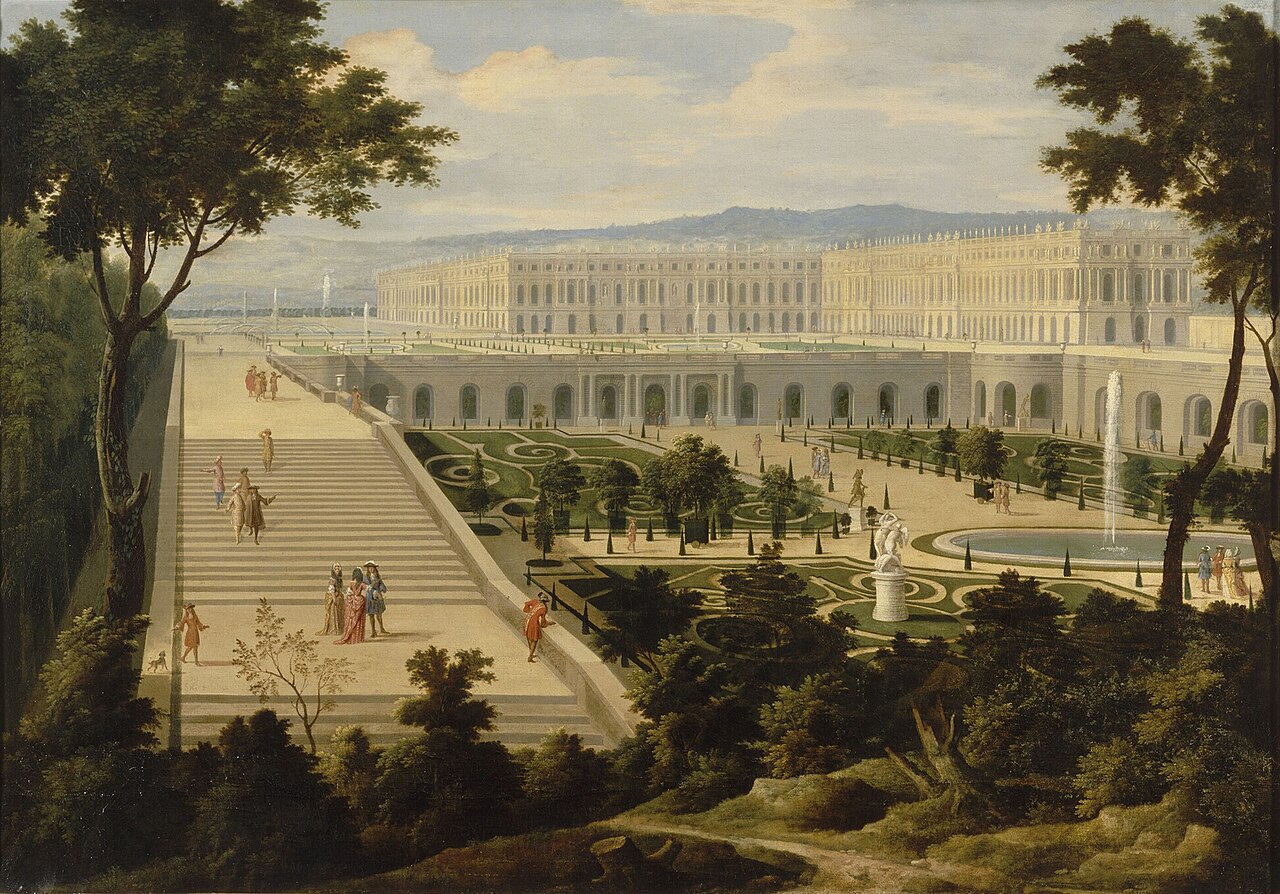
Recorded under Étienne Allegrain and Jean-Baptiste Martin; Versailles collection; public domain. [Source: commons.wikimedia.org]
The nineteenth century: iron and glass changed greenhouse dimensions
Advances in glass and metal production made larger spans and greater glazed areas possible. In the excerpt from Allain’s book, Louis Noisette’s 1825 definition describes a greenhouse as a glass-covered space for keeping and producing plants, with a classification by internal temperature. This stage shows how the term acquired a clearer technical meaning. [Source: www.quae.com]
One famous example is the Palm House at Kew in Britain, built between 1844 and 1848 to designs by Decimus Burton and iron founder Richard Turner. Its construction drew on shipbuilding experience. It was intended to house and study tropical plants. It demonstrates the engineering possibilities of iron and glass, but should not be described as the first greenhouse or the world’s first vegetable-production greenhouse. [Source: www.kew.org]
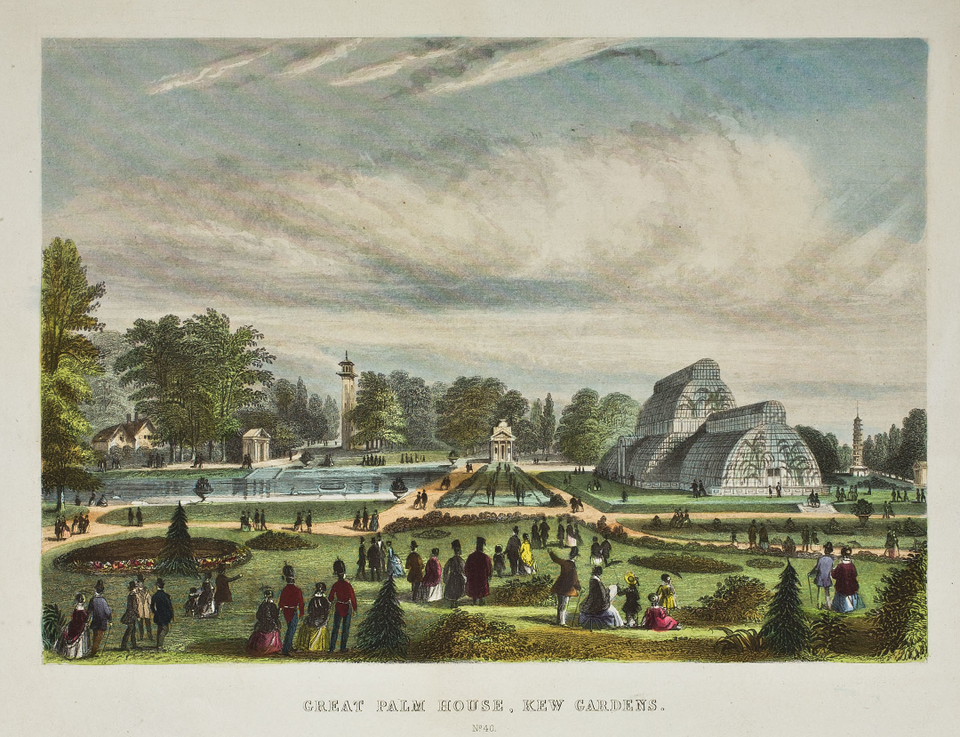
Thomas Hosmer Shepherd; Wikimedia Commons; public domain. [Source: commons.wikimedia.org]
North America also has documented examples predating this period. Mount Vernon’s greenhouse in the United States was completed in 1787 and housed tropical and subtropical plants. The estate’s official history also explains the contribution of enslaved workers. Greenhouse history is not only the history of architects and owners, but also of labour and daily plant care. [Source: www.mountvernon.org]
The twentieth century: greenhouses became a tool for widespread production
During this century, the subject moved beyond simply covering plants. A 1973 United States Department of Agriculture report devotes separate sections to light, heating, cooling, carbon dioxide, humidity and the root zone. Managing multiple environmental factors therefore predates today’s AI wave by decades. New systems build on that horticultural and engineering knowledge; their novelty lies more in continuous measurement, connected data and coordinated decisions. [Source: ageconsearch.umn.edu]
What changed with plastic coverings?
Lightweight coverings enabled simpler structures and the expansion of covered cultivation. The USDA’s 1973 historical report describes Emery Emmert’s experiments in Kentucky: in 1948 he covered a wooden structure with cellophane and used polyethylene a few years later. The same report dates the Kentucky Agricultural Experiment Station’s plastic greenhouse to the winter of 1953–1954. Thus, the first experimental covering and the spread of polyethylene were not a single event. [Source: ageconsearch.umn.edu]
Films subsequently became more than inexpensive covers. UV-stabilising additives, condensation-droplet control, management of radiative heat loss and light diffusion changed their performance. A covering should be selected using the particular film’s technical sheet and the cultivation conditions; “greenhouse plastic” alone is not an adequate specification. [Source: www.umass.edu]
How did Spain become an important example?
In Almería, plastic greenhouse construction was linked to farmers’ local experience, sand-based growing systems and demand for out-of-season produce. Historical research published in Rural History describes trials with plastic covers in Roquetas de Mar from 1963. Expansion accelerated during the 1970s. Low-cost local structures, followed by localised irrigation and commercial networks, contributed to the transformation. [Source: www.cambridge.org]
Almería’s success therefore cannot be attributed to roof shape alone. Research on the region also identifies changes in landholding, investment, access to water and the organisation of production. The practical lesson for investors is clear: greenhouse construction should be evaluated together with an operating and sales plan. [Source: www.cambridge.org]
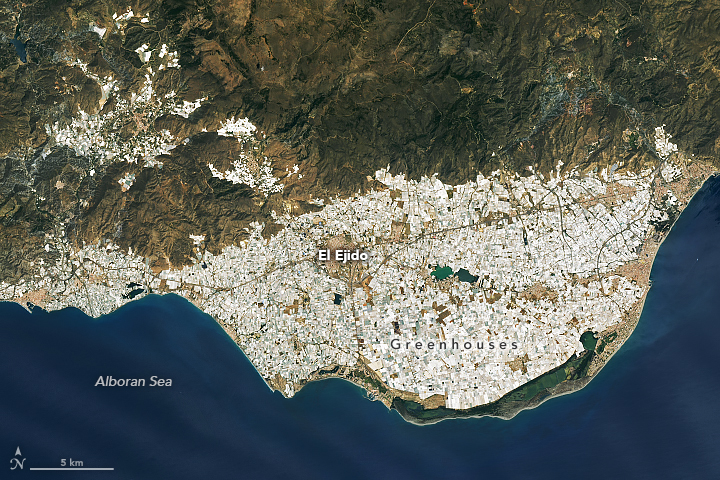
NASA Earth Observatory / Lauren Dauphin; USGS data. [Source: science.nasa.gov]
To understand structural features, read our Spanish greenhouse structure article and plastic greenhouse construction and starting cultivation guide alongside this history. The commercial label “Spanish design” does not replace project engineering specifications: span, height, loads, ventilation and covering must be defined separately.
A timeline of major milestones in greenhouse construction
| Period | Documented example | Main development |
|---|---|---|
| First century CE | Ancient Rome | Movable beds and translucent stone coverings: precursors of greenhouses |
| Mid-fifteenth century | Korea, Sangayorok | Instructions for winter cultivation using heating and light-transmitting covers |
| Seventeenth and eighteenth centuries | European orangeries, including Versailles | Architecture protecting cold-sensitive plants |
| 1787 | Mount Vernon, United States | Documented protection of tropical plants in North America |
| 1844–1848 | Kew Palm House, Britain | Large iron-and-glass structure for a plant collection |
| 1940s–1960s | Experiments with and expansion of plastic films | Lighter coverings and more economical structures |
| 1963 and subsequent decades | Almería, Spain | Expansion of plastic greenhouses within a commercial production cluster |
| Since 2018 | Wageningen Autonomous Greenhouse Challenge | Trials of crop management using data and AI |
This table selects milestones; its sequence does not imply direct technology transfer from each country to the next. Historical sources appear in the relevant sections; the final row is based on Wageningen’s programme. [Source: www.wur.nl]
What does the global greenhouse industry look like today?
A study by Tong and colleagues published in Nature Food in 2024 used satellite imagery to map approximately 1.3 million hectares of greenhouse infrastructure in 2019. About 60% of the identified coverage was in China. These figures are that study’s estimates for 2019, not definitive current statistics or a total for every type of protected cultivation. [Source: portal.research.lu.se]
NASA’s account of the study reports greenhouses identified in 119 countries. This geographical breadth means that no single model defines the industry: cold regions consider winter energy and light; hot, dry regions consider heat removal and water use; humid regions consider ventilation and disease management. The following sections examine selected examples, not a comprehensive country ranking. [Source: science.nasa.gov] [Source: www.fao.org]
Europe: from historical heritage to engineering and efficiency
The Netherlands: precise environmental control and links between research and production
The Netherlands’ role extends beyond area to greenhouse knowledge and technology. Wageningen University’s programme, which has invited teams to manage crops using algorithms, sensors and plant models since 2018, is a clear example. In the 2024–2025 edition, automatic control covered a complete tomato crop cycle. Lighting, heating, carbon dioxide dosing, irrigation and fertilisation are linked to a decision-making system. This research achievement does not mean that every Dutch greenhouse is automated. [Source: www.wur.nl]
Spain: economic adaptation to climate and markets
Almería exemplifies a large cluster of plastic greenhouses; NASA satellite images reveal its extensive landscape. The difference between this model and an energy-intensive greenhouse in a cold climate lies in the combination of climate, structure and operation. Comparisons should consider crop, production season and total cost; simply being “European” is not a selection criterion. [Source: science.nasa.gov]
France, Italy and Britain
France: CTIFL trials in 2026 focused on dehumidification, thermal screens and climate management, showing that optimisation continues after construction. Italy: a project reported in Sicily investigates hydroponic tomatoes using sensors and innovative films, linking Mediterranean production with new technology. Britain: Kew’s heritage remains a place for plant conservation and study. Botanical greenhouses have a different historical role from commercial food production, and both belong in the industry’s story. [Source: www.ctifl.fr] [Source: terra.regione.sicilia.it] [Source: www.kew.org]
Asia: large scale, solar greenhouses and climate-adapted technology
China: extensive production and diverse structures
China is not limited to large glasshouses. In a Chinese solar greenhouse, the north wall can store and release solar heat, while a night covering helps reduce losses. A 2024 research review shows that structural design, materials and environmental control have followed different paths. The performance of one example should not be generalised to every region without examining climate and crop. [Source: www.mdpi.com]
Landsat images of Weifang in 1987 and 2024 clearly show the changing landscape. NASA explains this expansion in relation to domestic demand and out-of-season production. For further detail on the industry and its companies, our article on greenhouse construction in China complements this section. [Source: science.nasa.gov]

NASA Earth Observatory / Lauren Dauphin; USGS data. [Source: science.nasa.gov]
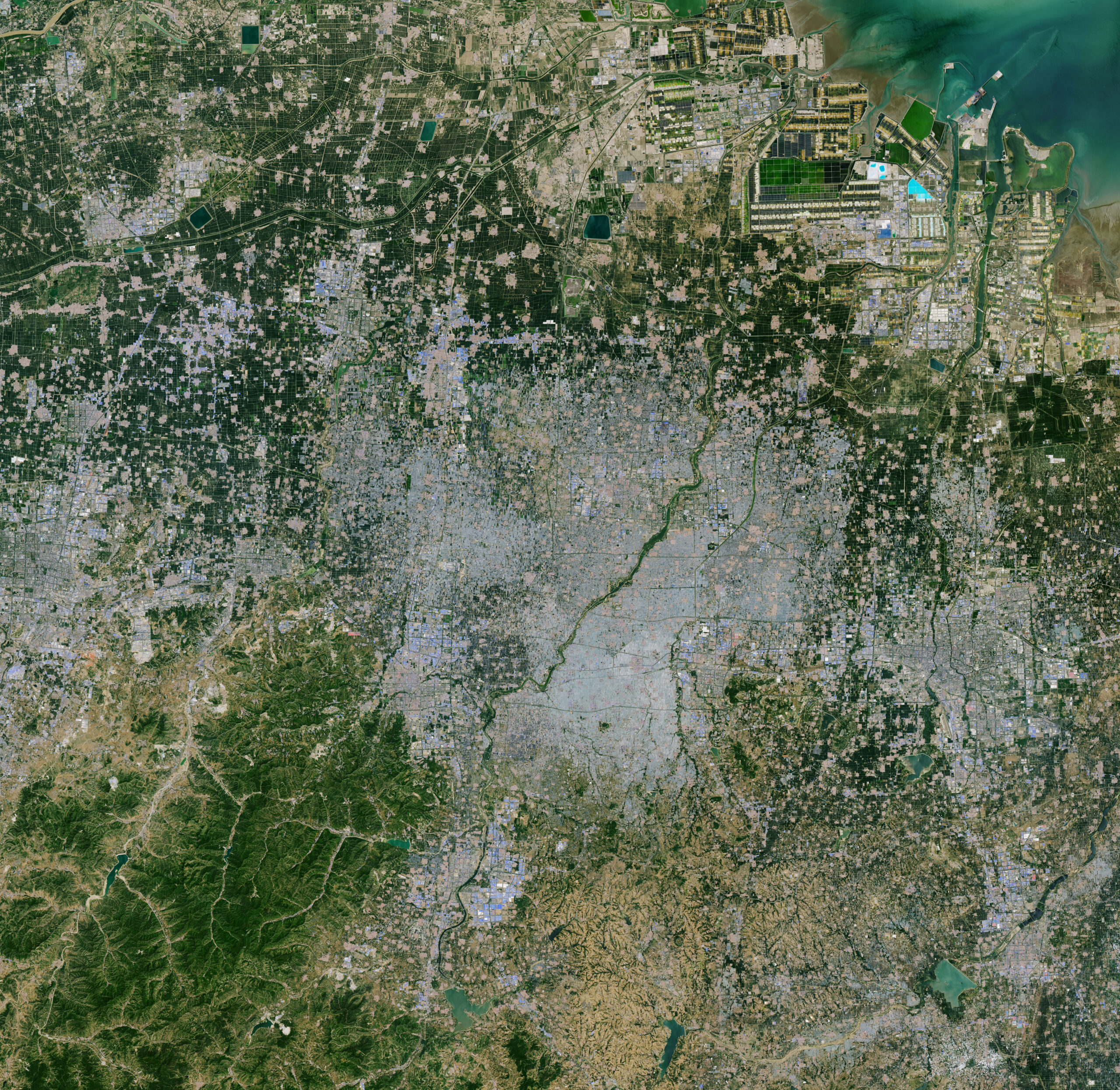
NASA Earth Observatory / Lauren Dauphin; USGS data. [Source: science.nasa.gov]
Public support has also shaped China’s trajectory. In 2023, the agriculture ministry emphasised upgrading old facilities, developing solar greenhouses, innovation and financial support. The document indicates policy direction; announcing a programme should not be equated with achieving all its objectives. [Source: english.moa.gov.cn]
Japan and South Korea: smart systems alongside training
Japan: the official next-generation greenhouse horticulture programme combines IT-based environmental control, planned production, sales links and local energy sources. It also includes upgrading existing structures. South Korea: smart-farming support centres were designated in 2025 for training, technology development, equipment and data analysis. In both examples, installing equipment without training operators is not considered sufficient. [Source: www.maff.go.jp] [Source: www.mafra.go.kr]
Turkey and India: production expansion and support for protected cultivation
Turkey: a historical review dates the start of greenhouse production to the 1940s and relates subsequent growth to plastic coverings and infrastructure development. Turkey is an important example of Mediterranean cultivation linked to commercial expansion. The older statistics in the 2005 research paper should not be treated as current national figures. [Source: doi.org]
India: the MIDH programme provides government support for developing protected cultivation. It illustrates how public policy and investment assistance can contribute to greenhouse expansion. A support programme does not replace assessment of the structure, crop and operating conditions. [Source: www.pib.gov.in]
Saudi Arabia and the UAE: heating is not the only concern
Saudi Arabia: KAUST research into cooling materials and methods shows that preventing unwanted heat gain can matter as much as supplying heat in hot climates. These are research findings and directions, not guarantees for every commercial project. UAE: ICBA’s research facilities in Dubai focus on agriculture in dry and saline conditions, illustrating the need to align the structure and growing system with water quality. [Source: www.kaust.edu.sa] [Source: www.biosaline.org]
The Americas: from seasonal tunnels to concentrated commercial production
United States: high tunnels are used alongside advanced technologies. The NRCS programme supports these structures to extend production seasons and protect crops from adverse conditions. Progress does not always mean the maximum amount of equipment: a simple structure can suit a specific purpose. [Source: www.nrcs.usda.gov]
Canada: official 2024 statistics report 33.3 million square metres of greenhouse area, with nearly two-thirds in Ontario. Tomatoes, peppers and cucumbers accounted for an important part of greenhouse food production. These figures retain their reference year and are not presented as 2026 statistics. [Source: www150.statcan.gc.ca]
Mexico: the official system separately includes greenhouses, low and high tunnels, and shade structures within protected agriculture. This diversity matters in comparisons: protected-cultivation area is not necessarily the area of fully climate-controlled greenhouses. [Source: nube.agricultura.gob.mx]
Colombia: AGROSAVIA’s greenhouse tomato guide connects site design, seedlings, nutrition, plant training and pest management in one production chain. Brazil: Embrapa explains protected cultivation in relation to variations in temperature, rain and wind. Ecuador: Expoflores, founded in 1984, illustrates the organisation of the flower and export-market chain. These examples show why Latin American greenhouse history should be read alongside crops and markets, not merely building covers. [Source: repository.agrosavia.co] [Source: www.embrapa.br] [Source: www.expoflores.com]
Africa: varied approaches to vegetables, energy and production development
Morocco: INRA research in Souss-Massa examined how greenhouse shape and dimensions affect internal climate and tomato performance in multispan and Canarian structures. Its importance lies in testing designs under actual production conditions; one experiment cannot be generalised to every greenhouse in the country. [Source: www.inra.org.ma]
Tunisia: a report to the 2010 World Geothermal Congress describes a government programme using geothermal energy for greenhouses in Kebili that began in 1986. It demonstrates how a local energy source can influence greenhouse development. [Source: pangea.stanford.edu]
Kenya: KALRO’s official training manual devotes a chapter to greenhouse tomato cultivation and emphasises training and locally appropriate technology. South Africa: the Agricultural Research Council describes protected hydroponic vegetable production while also highlighting expertise, daily management and sales markets. Egypt: the opening of a phase of the national greenhouse project in 2019 illustrates development through large public programmes. [Source: keep.kalro.org] [Source: www.arc.agric.za] [Source: sis.gov.eg]
Oceania: the Australian example
The government of New South Wales describes protected cultivation as a range from simple structures to advanced greenhouses. At the advanced end, controlled environments and hydroponics are combined, with training and research support also contributing to development. This spectrum is useful: each project should select the technology it needs, rather than assuming every lightly equipped structure is unsuitable or every complex structure successful. [Source: www.dpird.nsw.gov.au]
Why do greenhouse styles differ around the world?
| Model | Main design problem | Consideration when choosing a project |
|---|---|---|
| Historical orangery | Winter protection of sensitive plants | Not the same as a greenhouse for continuous commercial production |
| Glass greenhouse | Light, structure and environmental control | Assess energy and operating costs alongside the structure |
| Plastic and multispan greenhouse | Covering, ventilation and construction cost | Film quality and vent design matter |
| High tunnel | Protection and extending the growing season | Not every tunnel provides complete temperature control |
| Chinese solar greenhouse | Capturing, storing and retaining solar heat | Orientation, wall and climate should be examined together |
| Smart greenhouse | Coordinated measurement and decisions | Sensors and software do not replace sound design and plant knowledge |
This table is an analytical synthesis of the article’s historical and technical sources. These models are not mandatory stages replacing one another; they coexist today.
Lessons from history for greenhouse design and construction in Iran
Our practical conclusion is to define the project before selecting a model: what crop will be grown, in which season and climate, using which water and energy resources, and for which market? Structure, covering, ventilation and cultivation method should then be aligned with those requirements. Rah Nik Kesht’s plastic greenhouse design and construction service is a starting point for assessing a project.
Natural ventilation depends on wind, temperature differences and vent positions; it is not sufficient on its own in every situation. FAO’s Mediterranean greenhouse guide discusses this. When choosing insect netting, pest exclusion and airflow should therefore be considered together. Greenhouse shade netting should likewise match the crop’s light requirements. [Source: www.fao.org]
Growing media, supports and equipment become meaningful after the cultivation method is chosen. Information on coco peat, greenhouse twine and plant clips should be matched to root management and crop training. These links help evaluate related equipment; none replaces a crop plan or structural calculations.
The future of greenhouse construction: what is really changing?
Recent research reveals two clear directions: more precise data-based decisions and a lower environmental cost of climate control. CTIFL trials on dehumidification and screens, and Wageningen’s autonomous-control programme, are concrete examples. However, energy savings in one experiment cannot be transferred to every country and crop without calculation. [Source: www.ctifl.fr] [Source: www.wur.nl]
For an investor, the future question is not simply “Which new technology should we buy?” It is also whether the technology can be maintained, the operator is trained, the data are reliable and the crop has a market. South Africa’s guide also identifies management, expertise and markets as essential conditions for a commercial operation. A modern greenhouse depends on coordinating these elements. [Source: www.arc.agric.za]
Further questions about the evolution of greenhouse construction
How did covered plants receive light before glass became widespread?
Not every early shelter used glass. Ancient Roman accounts mention translucent, cleavable lapis specularis. Korea’s winter-cultivation instructions used translucent oiled paper. These materials admitted some light, but their properties differed from today’s industrial coverings. [Source: doi.org] [Source: www.jstor.org]
How did historical orangeries differ from production greenhouses?
Many orangeries primarily sheltered citrus and sensitive plants during winter; the plants returned outdoors in warmer weather. A production greenhouse is designed to manage the crop cycle and produce a harvest. A historical building with thick walls and large windows therefore did not necessarily serve the same purpose as a modern commercial greenhouse. [Source: en.chateauversailles.fr]
How did shipbuilding influence greenhouse construction?
Kew’s Palm House drew on shipbuilding expertise in working iron and making curved components. It shows that greenhouse progress was not solely agricultural: skills transferred from other industries also enabled larger, better-lit structures. [Source: www.kew.org]
Why did Almería become a broad production region rather than just a location for a few successful greenhouses?
Historical research identifies several interacting factors: farmers’ experience, economical structures, access to water, investment, changes in landholding and market connections. Regional growth did not result from a covering or roof shape alone. The lesson for developing a greenhouse region is to consider production, infrastructure and sales together. [Source: www.cambridge.org]
Did greenhouse environmental control begin with artificial intelligence?
No. The USDA’s 1973 report already examined light, heat, cooling, humidity, carbon dioxide and the root environment. AI builds on this existing knowledge. Its important difference is the use of continuous data and models to coordinate cultivation decisions, as illustrated by Wageningen’s Autonomous Greenhouse Challenge. [Source: ageconsearch.umn.edu] [Source: www.wur.nl]
What do satellite images reveal about greenhouse expansion?
Satellite images help identify the distribution of structures and compare land-surface changes over time, as in the Weifang images from 1987 and 2024. The visible area alone, however, does not establish profitability, crop quality or the technology inside each greenhouse. Production and operating information are needed for those questions. [Source: science.nasa.gov]
Sources and research method
This article synthesises historical research, books, research-institution documents and official reports. For early dates, it uses the concept of documented evidence: an early example does not prove direct technology transfer to every later country. National examples illustrate the industry’s diversity; they are neither a list of every active country nor a ranking of greenhouse companies.
Three important book-length references are Dana G. Dalrymple’s Controlled Environment Agriculture: A Global Review of Greenhouse Food Production, USDA, October 1973; the official excerpt from Yves-Marie Allain’s Une histoire des serres: De l’orangerie au palais de cristal, Quæ, 2010; and FAO’s Good Agricultural Practices for Greenhouse Vegetable Crops, report 217, 2013. Allain’s full book was not reviewed; citations here are limited to the publisher’s available excerpt.


