






Why do plant clips break? Choosing quality clips and reviewing Tekpar 27 mm
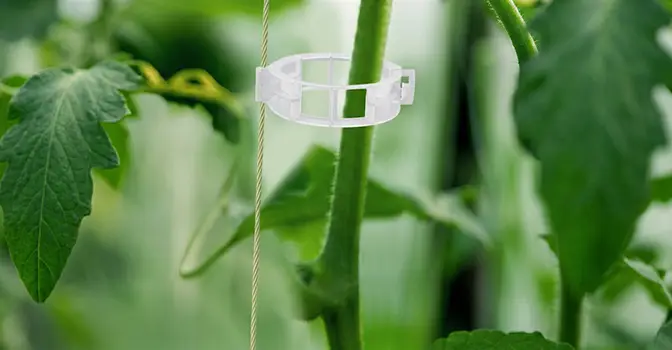
A clip that breaks during installation is more than a discarded part: it also consumes a worker’s time. If the lock opens after installation or the attachment slips on the twine, the plant needs attention again. The price per clip alone therefore does not show which product is more economical for a greenhouse.
When buying quality plant clips, assess the part at three stages: closing it, attaching it to the twine, and throughout plant growth. This article reviews those criteria and explains the stated features of the Tekpar 27 mm plant clip.
What are the hidden costs of brittle clips?
The consequences depend on the clip’s position, the plant’s condition and the other attachment points. Consider three possible costs:
- Installation waste: a broken clip has been consumed without making a connection.
- Rework time: fetching another part, closing it again and checking the connection take time.
- Correcting a faulty connection: opening or slipping may require the stem’s position to be adjusted.
This does not mean every inexpensive clip is defective. Judge the number of sound connections and actual performance, rather than price or country of manufacture alone.
Five practical checks before buying plant clips in bulk
1. How does the hinge behave when closing?
The hinge should withstand normal installation movement. Close several samples from the pack using your usual method and check for cracks or breakage.
This is an initial check. A few samples surviving a manual test do not prove the entire batch will last a season. For bulk purchases, also trial samples in a limited greenhouse area.
2. Does the lock close fully without repeated attempts?
The lock should engage correctly, and the installer should be able to recognize closure. International manufacturers also emphasize this: ARaymond highlights an audible click, while Bato describes a firm connection and easy opening for its Clip 21. Source: ARaymond, Source: Bato
When comparing samples, record how many attempts each clip takes to close. Small differences matter across thousands of installations.
3. Is the clip compatible with your greenhouse twine?
Test the sample with the same twine used in your greenhouse. Connection quality depends on both parts working together.
The University of Florida guide describes securing the twine in the clip’s hinge while the ring surrounds the stem. Closing the ring around the stem without correctly securing the twine does not complete this method. Source: University of Florida
For the other part of the connection, read choosing quality greenhouse twine.
4. Is the contact surface suitable for the stem?
Look carefully for uneven edges, sharp protrusions or unsuitable dimensions. Tekpar describes a curved, plant-friendly design among its clip features. Source: Tekpar body clips
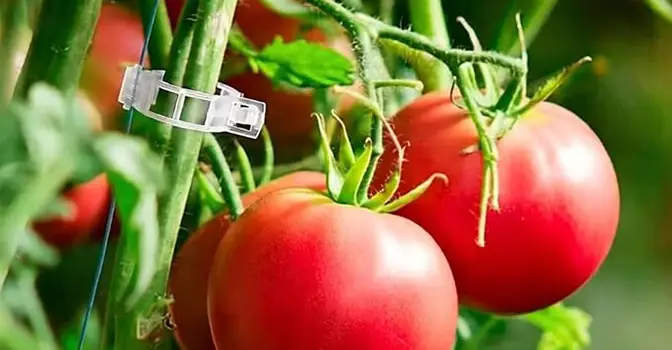
Good design does not replace correct installation. For tomatoes, the University of Florida recommends placing the clip below a large leaf and avoiding the flower-truss attachment point, where the truss stem could be damaged. Source: University of Florida
5. Does the clip size suit the stem?
Bigger is not necessarily better. Consider stem diameter, growth stage and training method. A clip should not exert inappropriate pressure on the stem just to close.
For applications and installation, see the greenhouse plant clip guide.
What features does the Tekpar 27 mm plant clip have?
Tekpar’s official body-clip page emphasizes quick, practical installation, curved design, strength and grip. Its product table lists models GR-015 and GR-015B with a 27 mm diameter.
These specifications let buyers compare the purchased product with manufacturer information. Check the model code and packaging details when ordering. Source: official Tekpar specifications
To see the product offered by Rah Nik Kesht and ask about the available model, visit the plant clip product page. Check size and twine compatibility alongside product quality.
Can clips be used for several seasons?
It depends on the product. Tekpar offers virgin-material and recycled-material options for greenhouse accessories. It presents virgin-material options as intended for greater durability and multiple seasons, and its recycled options for single-season use. Source: Tekpar material information
Check reusability for the model you buy. An intact appearance is not enough: assess hinge and lock condition and greenhouse hygiene requirements too.
A simple way to compare costs
Test two samples under similar conditions and record:
| Check | Information to record |
|---|---|
| Initial waste | Number of broken or unusable clips |
| Installation ease | Time to install the same number of clips |
| Connection performance | Observed unlocking or slipping |
| Rework | Time spent correcting connections |
As a hypothetical example, a one-second difference per installation amounts to about two hours and 47 minutes over 10,000 installations. This calculation is not about a particular brand; it illustrates the importance of labor time.
To calculate actual cost, add purchase costs, installation time costs and connection-repair costs. Record discarded parts too, so the cost per sound connection can be determined.
This helps assess whether a higher-quality clip’s price difference is justified by better performance.
Frequently asked questions
Does breakage always indicate poor raw materials?
Breakage alone cannot establish the cause. Manufacturing quality, storage conditions, application suitability and installation method all need checking.
Is the Tekpar 27 mm clip suitable for every plant?
No. Size must suit the stem and training method. Testing samples before a bulk order helps make a more accurate choice.
What is the main benefit of a quality clip?
A more reliable connection and a lower likelihood of waste and rework when selection and installation are correct. Calculate savings using real greenhouse data.
Before buying, request model specifications and samples. A clip that installs easily in practice, makes a suitable connection and is designed for the intended usage period provides a sounder basis for an economical purchase.


